
How Flightpath.AI actually works.
Every tool in Peregrine OS runs on Flightpath.AI. This page is the honest version of "how it works": what it reads, how it scores what it finds, what happens when a source is briefly down, and exactly what's kept private to your account. No hand-waving.
Four things happen before you ever open a tool
Same pipeline, every tool, every day.
Reads
Each feed watches a different slice of the open web, continuously, not queried on request. Some read live search results and licensed news APIs; others read a fixed set of RSS feeds from marketing and business trade publications; account enrichment reads public SEC filings and technographic data on a company's technology stack.
Five feeds run on a staggered daily schedule, so new signal is waiting when you sit down rather than all landing at once.
Scores
Every signal gets scored against the same rubric before it reaches you: relevance, timing, and fit. What lands in a feed is already the short list. For technographic enrichment, that scoring is a deterministic rule applied to a company's detected tech stack. For the daily feeds, the same scoring instruction runs against every item, automatically, every time.
There's no secret ranking algorithm behind it, just a fixed rubric applied consistently. That consistency is the point.
Writes
Raw signal becomes a snapshot, a briefing, or an outreach line, written in your voice and ready to send. Each tool has its own writing task: Quickstrike writes a pre-call snapshot on one contact, Kestrel writes a full account brief, Merlin writes a media plan, same underlying engine, different job.
Remembers
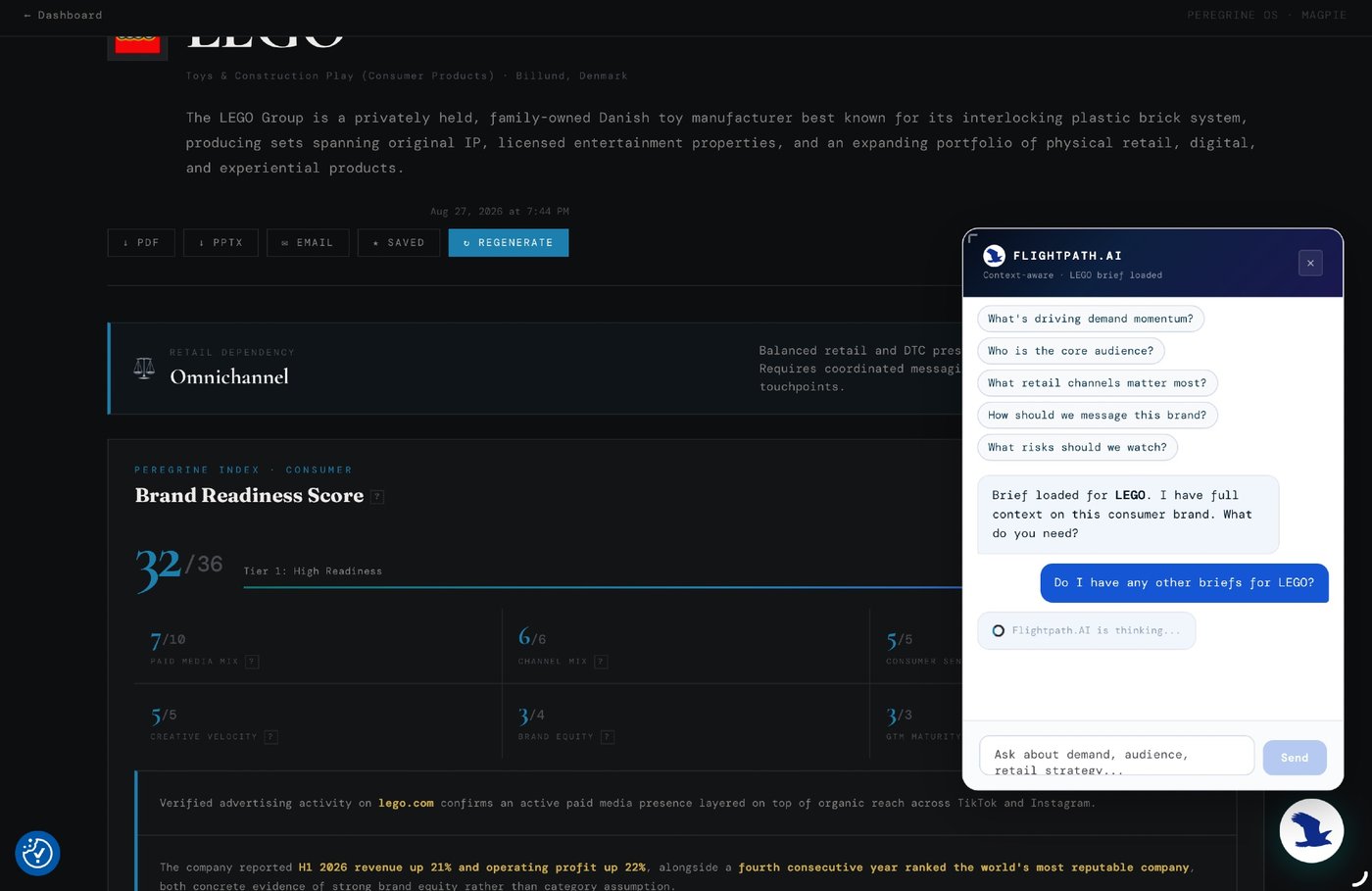
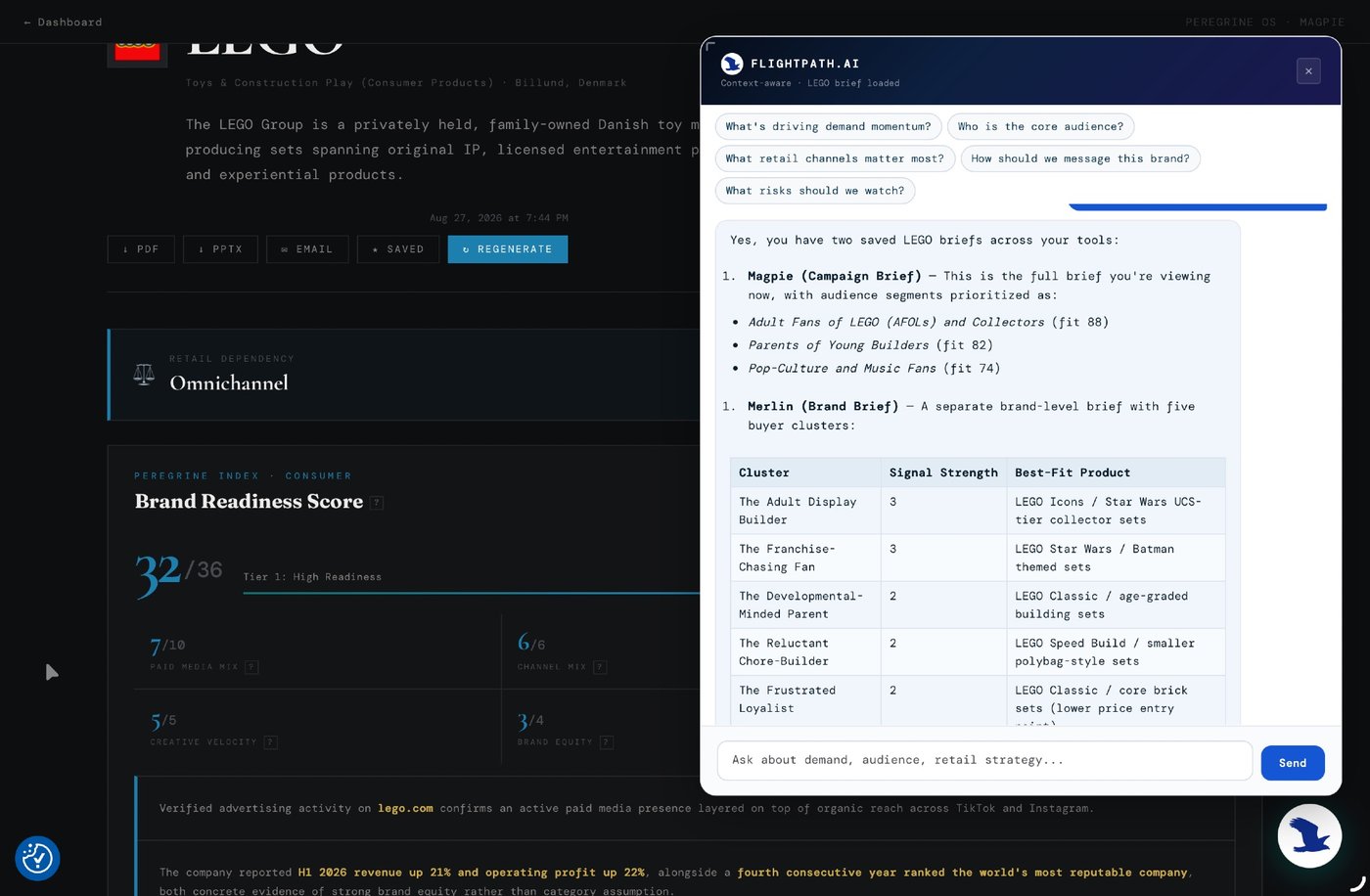
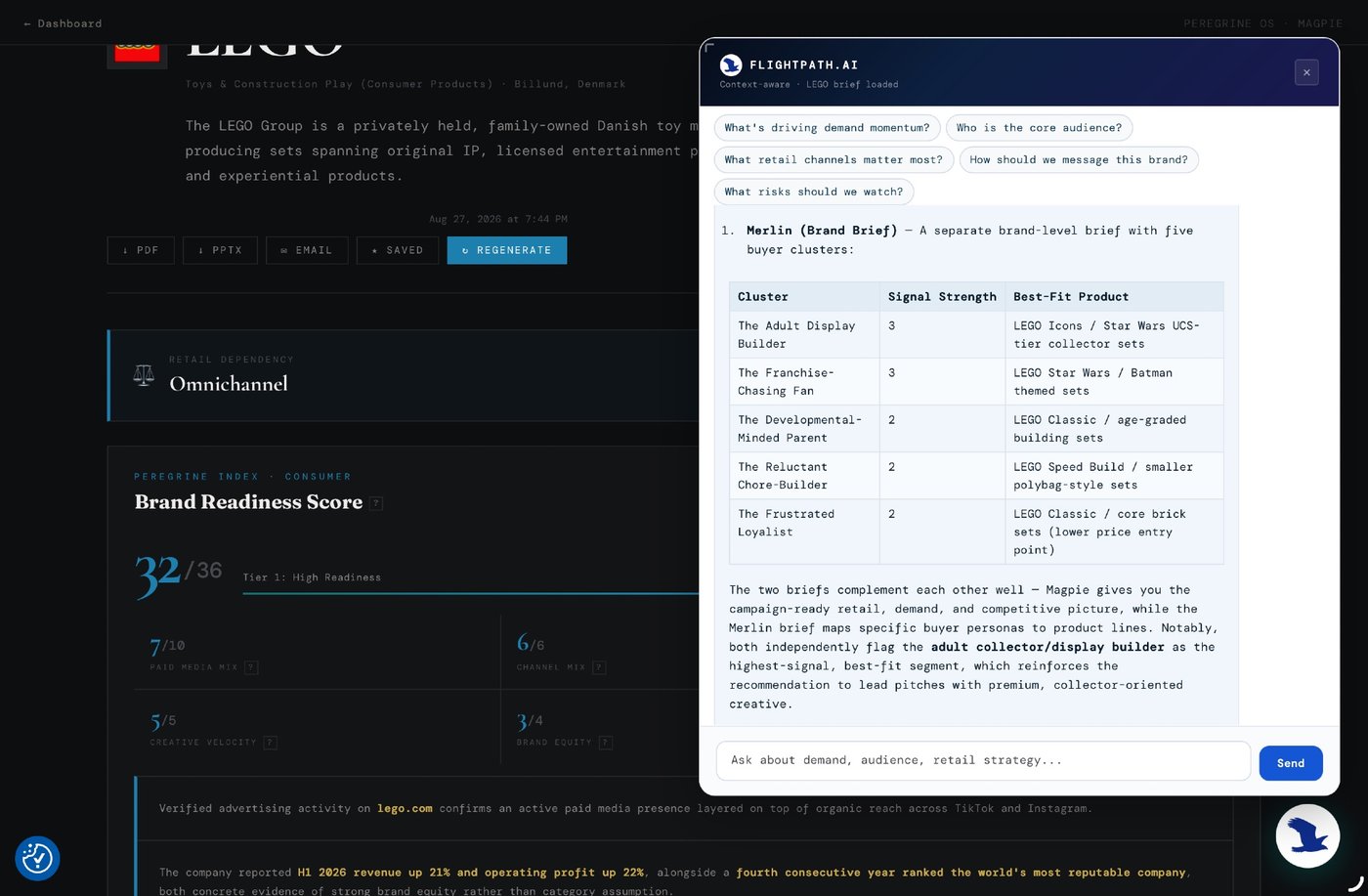
Every account brief, prospect snapshot, and campaign plan you save is scoped to your account. The Flightpath assistant pulls from everything you've saved, across every tool, the next time you ask it a follow-up question, so research from a Kestrel brief is there when you're prepping a Quickstrike outreach line on the same account.
"Remembers" isn't just a word on this page
A real Magpie brief for LEGO, asked one follow-up question: no re-typing what you're researching, no switching tools first.
What that means in practice
The parts that actually matter when you're trusting an AI with your pipeline.
Your data stays yours
Every request is authenticated before any data returns. Briefs, snapshots, and plans you save are scoped to your account alone.
One source going down doesn't break a feed
Sources are fetched in parallel, so a single one being briefly unavailable doesn't take the whole run with it. Model overload is retried automatically with backoff rather than just failing.
Old signal gets pruned automatically
Every feed prunes its own stale rows on each run, so what you see always reflects the current window for that feed.
A consistent rubric, not a mood
Signals are scored the same way every time: by rule where the input is structured (like a technology stack), by a fixed rubric where it isn't. Nothing is cherry-picked by hand.
Built for the ten-tool reality
The same engine underlies prospect intel, briefings, and daily feeds, so what you learn in one tool is available context the next time you open a different one.
More detail, in writing
Full data handling practices (what's collected, how it's used, and how to reach us about it) are in the privacy policy.
Ready to fly?
Get started now: the tools that are live today are ready to go.
Get started